Report of Dr. Benjamin Franklin, and other commissioners, charged by the King of France, with the examination of the animal magnetism, as now practised at Paris
Also known as Rapport des commissaires chargés par le roi, de l'examen du magnétisme animal. English; Rapport des commissaires. English
by France Commissaires chargés par le roi de l'examen du magnétisme animal, Benjamin Franklin (Contributor), Paris Descartes University faculty of medicine, French Academy of Sciences, Jean Sylvain Bailly, Faculté de médecine de Paris, Académie des Sciences & Royal Society of Medicine
- First published:
- 18th century
- Languages: English, French
The Royal Commission on Animal Magnetism involved two entirely separate and independent French Royal Commissions, each appointed by Louis XVI in 1784, that were conducted simultaneously by a committee composed of four physicians from the Paris Faculty of Medicine (Faculté de médecine de Paris) and five scientists from the Royal Academy of Sciences (Académie des sciences) (the "Franklin Commission", named for Benjamin Franklin), and a second committee composed of five physicians from the Royal Society of Medicine (Société Royale de Médecine) (the "Society Commission"). Each Commission took five months to complete its investigations. The "Franklin" Report was presented to the King on 11 August 1784 – and was immediately published and very widely circulated throughout France and neighbouring countries – and the "Society" Report was presented to the King five days later on 16 August 1784. The "Franklin Commission's" investigations are notable as a very early "classic" example of a systematic controlled trial, which not only applied "sham" and "genuine" procedures to patients with "sham" and "genuine" disorders, but, significantly, was the first to use the "blindfolding" of both the investigators and their subjects. The report of the ["Franklin"] Royal Commission of 1784 ... is a masterpiece of its genre, and enduring testimony to the power and beauty of reason. ... Never in history has such an extraordinary and luminous group [as the "Franklin Commission"] been gathered together in the service of rational inquiry by the methods of experimental science. For this reason alone the [Report of the "Franklin Commission"] ... is a key document in the history of human reason. It should be rescued from obscurity, translated into all languages, and reprinted by organizations dedicated to the unmasking of quackery and the defense of rational thought. Both sets of Commissioners were specifically charged with investigating the claims made by Charles-Nicolas d’Eslon (1750–1786) for the existence of a substantial (rather than metaphorical) "animal magnetism", le magnétisme animal, and of a similarly (non-metaphorical) physical "magnetic fluid", le fluide magnétique. Further, having completed their investigations into the claims of d'Eslon – that is, they did not examine Franz Mesmer, Mesmer's theories, Mesmer's principles, Mesmer's practices, Mesmer's techniques, Mesmer's apparatus, Mesmer's claims, Mesmer's "cures" or, even, "mesmerism" itself – they were each required to make "a separate and distinct report". Before the ["Franklin" Commission's] investigations began, [Antoine Lavoisier] had studied the writings of d'Eslon and [had] drawn up a plan for the conduct of the inquiry. He decided that the commissioners should not study any of the alleged cures, but [that] they should determine whether animal magnetism existed by trying to magnetize a person without his knowledge or making him think that he had been magnetized when in fact he had not. This plan was adopted by the commissioners, and the results came out as Lavoisier had predicted. From their investigations both Commissions concluded (a) that there was no evidence of any kind to support d'Eslon's claim for the substantial physical existence of either his supposed "animal magnetism" or his supposed "magnetic fluid", and (b) that all of the effects that they had observed could be attributed to a physiological (rather than metaphysical) agency. Whilst each Commission implicitly accepted that there was no collusion, pretence, or extensive subject training involved on the part of d'Eslon, they both (independently) concluded that all of the phenomena they had observed during each of their investigations could be directly attributed to "contact", "imagination", and/or "imitation". For clearness of reasoning and strict impartiality [the "Franklin" Commissioners' report] has never been surpassed. After detailing the various experiments made, and their results, they came to the conclusion that the only proof advanced in support of Animal Magnetism was the effects it produced on the human body – that those effects could be produced without passes or other magnetic manipulations – that all these manipulations, and passes, and ceremonies never produce any effect at all if employed without the patient's knowledge; and that therefore imagination did, and animal magnetism did not, account for the phenomena. (This summary is from Wikipedia.)
Provenance
Why this book is in the catalog
Included because retained bibliographic metadata links this work to Mesmerism, animal magnetism, and hypnosis.
Controlled discovery queries from harvard, project-gutenberg, and wellcome matched “animal magnetism” and “mesmerism”. Retained metadata contains “Animal magnetism” in the title, “Animal magnetism” in the description, “Mesmerism” in the description, and 3 additional metadata match(es).
- “animal magnetism”· via Harvard LibraryCloud
- “animal magnetism”· via Project Gutenberg
- “mesmerism”· via Project Gutenberg
- “animal magnetism”· via Wellcome Collection
- “Animal magnetism”· in title
- “Animal magnetism”· in description
Membership records how this book met the catalog’s discovery criteria — relevance to a tradition, not a judgment of the book’s claims.
Read & download
Free, public copies reported by our sources. Links open the source directly.
- EPUB (opens in a new tab)
- HTML (opens in a new tab)
- Plain text (opens in a new tab)
- Landing page (opens in a new tab)
Project Gutenberg ebook; public domain in the USA. Public domain in the USA.
Wellcome digital item license: Public Domain Mark (https://creativecommons.org/share-your-work/public-domain/pdm/)
marks a direct file download. Rights vary by country; each source states its own terms.
Buy or borrow
No ISBN on record, so the Amazon link searches by title and author. WorldCat shows libraries near you that hold a copy.
Editions
3 editions cataloged here.
| Edition | Date | Publisher | Language | ISBN | Access | Links |
|---|---|---|---|---|---|---|
Harvard LibraryCloud bibliographic record xx, 108 p. ; 22 cm. | 1785 | — | English, French | — | Catalog record | |
Project Gutenberg electronic edition Project Gutenberg metadata does not identify the source print edition. | 2026-04-10 | Project Gutenberg | English | — | Public domain (USA) | |
Wellcome Collection bibliographic record xx, 108 pages ; 22 cm (8vo) | 1785 | Printed for J. Johnson | English | — | Public digitized item |
Subjects
More like this
Books that share this work's traditions, subjects, or authors.
Report of Dr. Benjamin Franklin, and other commissioners, charged by the King of France, with the examination of the animal magnetism as now practised at Paris
Benjamin Franklin, Royal Society of Medicine, France Commissaires chargés par le roi de l'examen du magnétisme animal
1785
- Read free
Vital magnetism: its power over disease
Frederick T Parson
1877
Animal magnetism
France Commissaires chargés par le roi de l'examen du magnétisme animal, Benjamin Franklin, Julio Mario Santo Domingo Collection
1837
- Read free
Lettre sur le magnétisme animal, où l'on examine la conformité des opinions des peuples anciens et modernes, des sçavans, et notamment de M. Bailly avec celles de M. Mesmer; et où l'on compare ces mêmes opinions au Rapport des commissaires chargés par le roi de l'examen du magnétisme animal
Galart de Montjoie, Jean Sylvain Bailly, Franz Anton Mesmer, France. Commissaires chargés par le roi de l'examen du magnétisme animal
1784French
De l'examen du magnétisme animal
Jean Sylvain Bailly, Benjamin Franklin, Joseph Michel Antoine Servan
1980French
Abrégé de l'histoire des magnétiseurs de Lyon
Un nouveau converti
1784French
- Read free
Lettre sur le magnétisme animal, où l'on examine la conformité des opinions des peuples anciens et modernes, des sçavans, et notamment de M. Bailly avec celles de M. Mesmer; et où l'on compare ces mêmes opinions au Rapport des commissaires chargés par le roi de l'examen du magnétisme animal
Jean Sylvain Bailly, Bern Dibner, France. Commissaires chargés par le roi de l'examen du magnétisme animal. n 83218021, 1746-1816. nr 93040969 Galart de Montjoie, Franz Anton Mesmer
1784French
- Read free
Animal magnetism
Benjamin Franklin, Académie nationale de médecine
1837
- Read free

Mémoire sur la découverte du magnétisme animal
Franz Anton Mesmer
1779French
- Read free
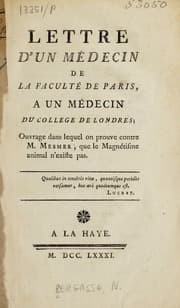
Lettre d'un médecin de la Faculté de Paris, a un médecin du College de Londres
Nicolas Bergasse, Un médecin de la Faculté de Paris, Franz Anton Mesmer, Faculté de Paris, College de Londres
1781French
- Read free

Mémoires pour servir à l'histoire et à l'établissement du magnétisme animal
A.-M.-J Chastenet marquis de Puységur, A.-M.-Armand-Marie-Jacques Chastenet de Puységur
1784French
- Read free
La vision, contenant l'explication de l'écrit intitulé: Traces du magnétisme, et la théorie des vrais sages
Jacques Cambry
1784French
Identifiers & provenance
How this record was assembled, and the authority identifiers it carries.
Identifiers
- OCLC
- Project Gutenberg
- Harvard
- 990016285060203941
- Wellcome
Cataloged from
- Harvard LibraryCloud990016285060203941 (opens in a new tab)
- Project Gutenbergprimary78413 (opens in a new tab)
- Wellcome Collectionenhgscmf (opens in a new tab)
Found via
Cataloging notes
- Original print publication date and source edition are absent from Project Gutenberg metadata.
- Catalog id
- project-gutenberg:78413
- Edition coverage
- Multi source partial
- Retrieved