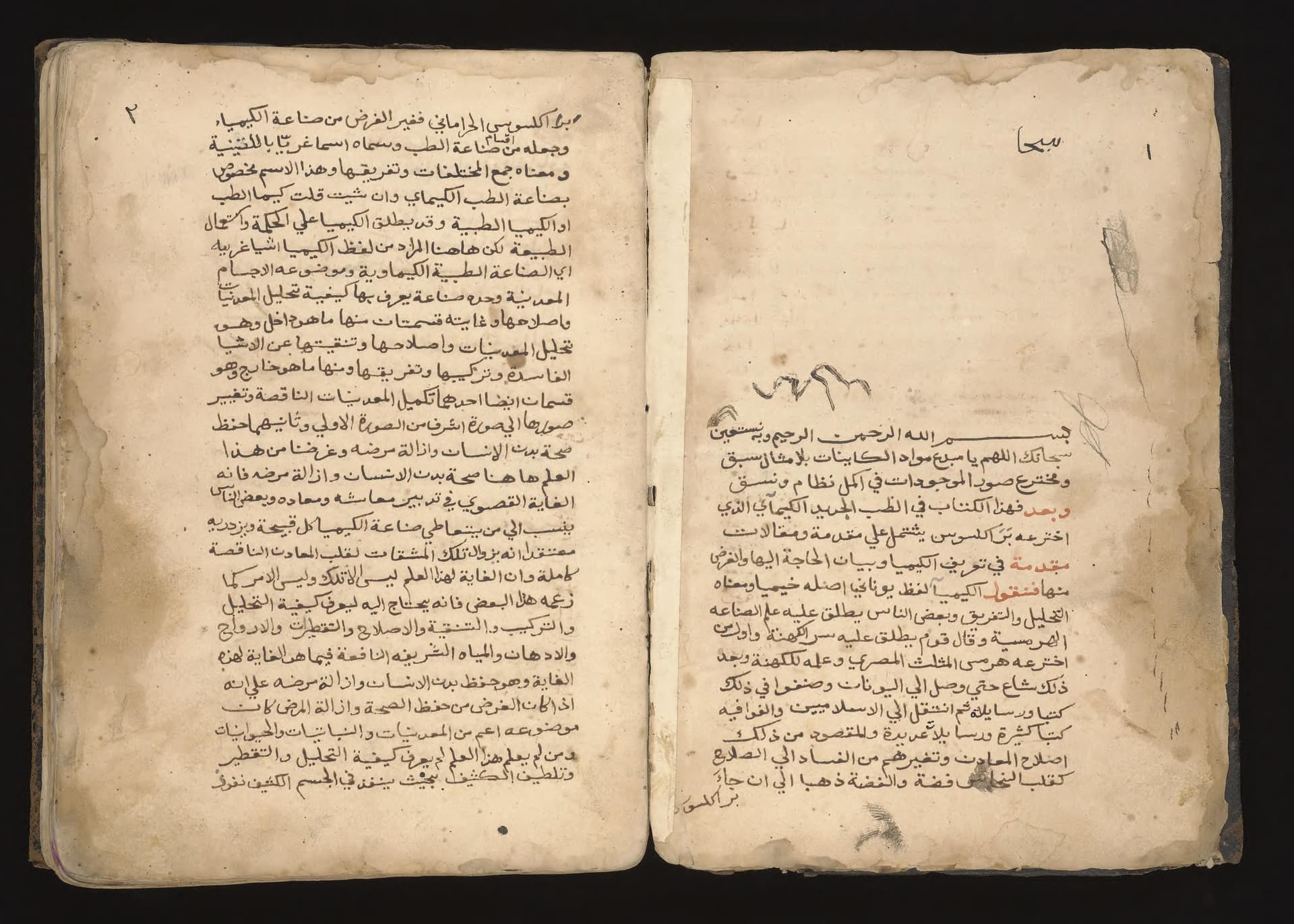
The New Chemical Medicine Invented by Paracelsus.
by Shaybān Al-Khāzinī, Oswald Croll, Ṣāliḥ Ibn-Naṣrallāh Ibn-Sallūm & Paracelsus
- First published:
- 17th century
- Language: Arabic
Al-Ṭibb al-jadīd al-kīmiyāʼī alladhī ikhtaraʻahu Barākalsūs (The new chemical medicine invented by Paracelsus) is an Arabic compendium of alchemical works from early modern Europe by Salih ibn Nasrallah al-Halabi ibn Sallum (died 1671). Ibn Sallum was a noted physician in Aleppo and subsequently chief physician in the Ottoman capital of Istanbul. Ibn Sallum's work is on iatrochemistry and consists of translations of Philippus Aureolus Theophrastus Bombastus von Hohenheim, known as Paracelsus (1493-1541), an alchemist, physician, and medical reformer, and of alchemist and physician Oswald Crollius (circa 1563--1609). The first part of Ibn Sallum's work is an Arabic translation of Paracelsus, which includes an introduction and four chapters (each of which are divided further into sections). The introduction, an overview of the history of alchemy, describes the invention of alchemy by "Hermes Trismegistus the Egyptian" (a legendary "thrice-great Hermes" to whom a large corpus of writing was attributed) and the subsequent transfer of alchemical knowledge to the Hellenistic and Islamic worlds. The book also discusses Paracelsus and his transformation of alchemy into a field of medicine, with a dual focus on the perfection and purification of metals and on preserving the health of the human body. Chapter one is entitled al-Juz' al-naẓarī min ashyā' gharība wa huwa al-ṭibb al-kīmīyā'ī fī al-umūr al-ṭabī'īya (On the speculative part of paranormal objects, i.e., alchemical medicine regarding the affairs of nature). This chapter includes a discussion of such topics as al-Hayūlā al-ūlā wa al-sirr al-akbar (prime matter and the great secret). The second chapter is entitled Asās ṭibb al-kīmīyā (On the principles of alchemical medicine). Presented in this chapter are sections on asbāb al-amrāḍ (the causes of illness), al-nabḍ (the pulse), and al-ʻalāj al-kullī (general treatments). The third chapter, Bayān kayfīyat tadbīr al-adwīya (On an explication of the manner of managing medicines), discusses chemical procedures involving metals and minerals. The fourth chapter, Fī al-ʻamaliyāt (On operations), discusses such procedures as the distillation of water. The second part of this compendium is an Arabic rendition of Basilica Chymica, by Crollius, who was influenced by Paracelsus. The first edition of Crollius's work was probably printed in 1609 in Frankfurt, with a French translation appearing in 1622. The Arabic version of this work, which takes up roughly the second half of the manuscript, deals with the general treatment of diseases as well as the treatment of ailments that are specific to various organs. The bismallah (in the name of God) and the invocation to God and the Prophet have been omitted from the introduction to this manuscript. Also omitted is the subsequent sentence which identifies the work, and lists Paraclesus as the inventor of the new alchemical medicine.
Provenance
Why this book is in the catalog
Included because retained bibliographic metadata links this work to Alchemy and Hermeticism.
Controlled discovery queries from library-of-congress matched “alchemy”. Retained metadata contains “alchemist” in the description, “Alchemy” in the description, and “Alchemy” in the subject metadata.
- “alchemy”· via Library of Congress
- “alchemist”· in description
- “Alchemy”· in description
- “Alchemy”· in subject
Membership records how this book met the catalog’s discovery criteria — relevance to a tradition, not a judgment of the book’s claims.
Read & download
Free, public copies reported by our sources. Links open the source directly.
Library of Congress digital item; consult the item record for rights and restrictions.
Not yet in passage search
Pro research answers quote indexed passages. Ask the library to index this book’s public text.
marks a direct file download. Rights vary by country; each source states its own terms.
Buy or borrow
No ISBN on record, so the Amazon link searches by title and author. As an Amazon Associate we earn from qualifying purchases. WorldCat shows libraries near you that hold a copy.
Editions
One edition cataloged here.
| Edition | Date | Publisher | Language | ISBN | Access | Links |
|---|---|---|---|---|---|---|
Library of Congress digitized edition | 1650-01-01 | — | Arabic | — | Public digital item |
Subjects
More like this
Books that share this work's traditions, subjects, or authors.
- Read free
The New Chemical Medicine Invented by Paracelsus.
Oswald Croll, Ṣāliḥ Ibn-Naṣrallāh Ibn-Sallūm, Paracelsus
1650Arabic
- Read free

The New Chemical Medicine Invented by Paracelsus.
Ṣāliḥ Naṣr Allāh Ibn Sallūm Alabī, Oswald Croll, Trismegistus Hermes, Paracelsus, Sayyid Shīr Shāh, Uthmānī, Muḥammad Ibn ʻalī
1640Arabic
- Read free

Wundt vnd Leibartznei
Paracelsus
1561German
- Read free

Of the chymical transmutation, the genealogy and generation of metals & minerals
Paracelsus, Ramon Llull, Andreas Tentzel, Stephen Trigg, Robert Turner
1657
- Read free
A Storehouse Of Physicall And Philosophicall Secrets
Paracelsus
1633
Medicina practica: or, a practical physick
William Salmon, Paracelsus, Hermes Trismegistus, Artephius, Nicolas Flamel, al-Umaw.̄ Khālid ibn Yazīd, Jābir ibn Ḥayyān, Roger Bacon, George Ripley, Jean Baptiste van Helmont, Ramon Llull
1692
A hundred and fourtene experiments and cures of the famous phisition Philippus Aureolus Theophrastus Paracelsus, translated out of the Germane tongue into the Latine. Whereunto is added certaine excellent and profitable workes by B.G., a Portu Aquitano. Also certaine secretes of Isack Hollandus concerning the vegetall and animall worke. Also the spagerick antidotarie for gunshot of Iosephus Quirsitanus. Collected by I.H
Paracelsus
1583
A hundred and fouretene experiments and cures of the famous physitian Philippus Aureolus Theophrastus Paracelsus; translated out of the Germane tongue into the Latin. Whereunto is added certaine excellent and profitable workes by B.G. a Portu Aquitano. Also certaine secrets of Isacke Hollandus concerning the vegetall and animall worke. Also the spagericke antidotarie for gunne-shot of Iosephus Quirsitanus. Collected by Iohn Hester
Paracelsus
1596
Epistola scripta Theophrasto Paracelso: in qua rario ordinis & nominum, adeóq
Peder Sørenson, Paracelsus
1572Latin
Labyrinthvs medicorvm errantivm
Paracelsus
1653Latin
Wunder Artzney, vonn allerley Leibs Gebrüchen, unnd zů fallenden Kranckheiten, ohn sondere Beschwerung, Unlust unnd Verdruss, kurtzlich zů heilen
Paracelsus
1573German
Opera omnia
Paracelsus, Milwaukee Academy of Medicine. Book Collection, Horace Manchester Brown Collection
1658Latin
Identifiers & provenance
How this record was assembled, and the authority identifiers it carries.
Identifiers
- Library of Congress
- 2021667372
Cataloged from
- Library of Congressprimary2021667372 (opens in a new tab)
Found via
- Catalog id
- library-of-congress:2021667372
- Edition coverage
- Multi source partial
- Retrieved